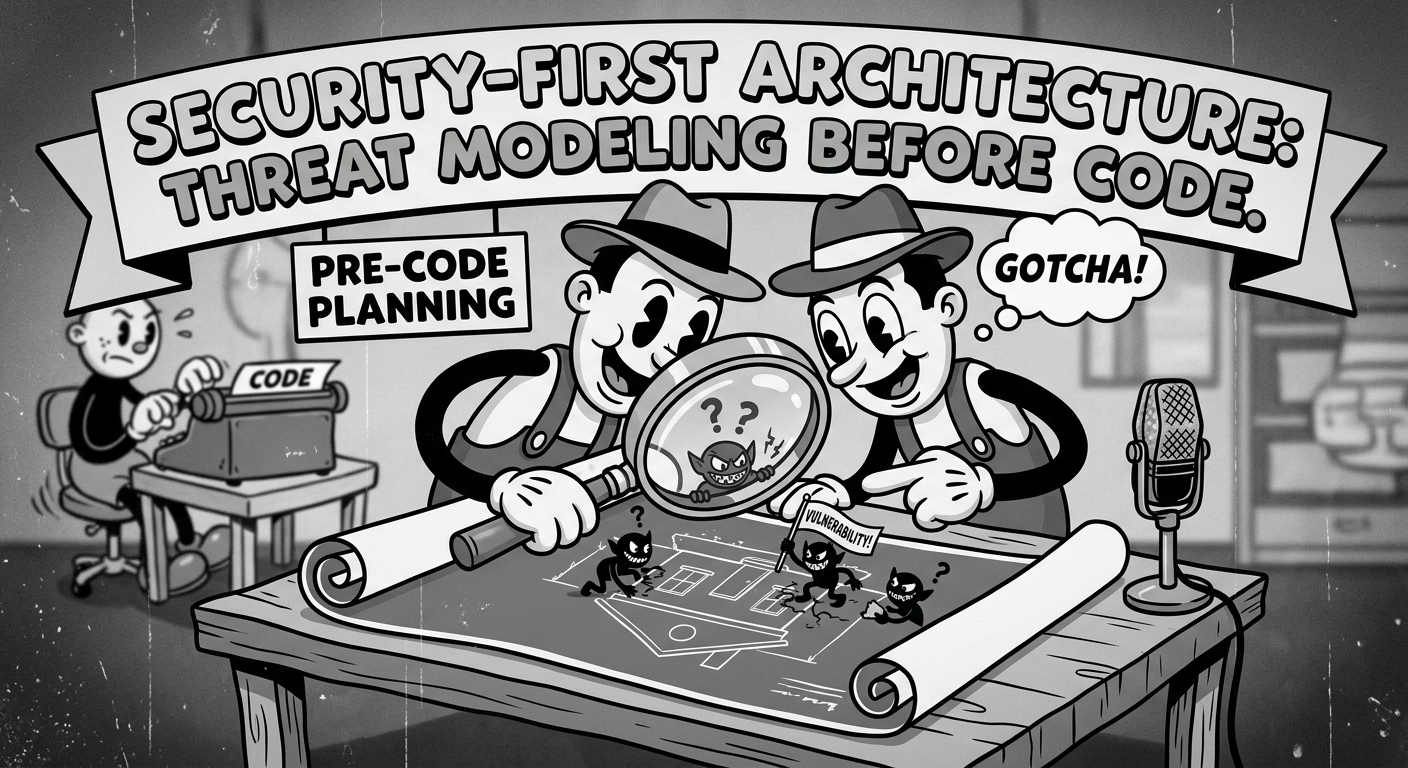
The Security-First Architecture: Designing Threat Models Before Writing Code
Every engineering leader has lived through the nightmare. A major feature is built, tested, demoed, and ready for deployment - only for a last-minute security review to flag a fundamental architectural flaw. Not a missing input check. Not a vulnerable dependency. A structural problem baked into the very shape of the system.
The result? Missed deadlines, frustrated developers, and a chaotic rush to patch a structural vulnerability with code-level band-aids. You can’t if-statement your way out of a broken trust boundary.
We lose when we treat security as a compliance gate welded onto the end of the delivery pipeline. Truly secure infrastructure isn’t built by patching code after the fact; it’s built by designing a Security-First Architecture - which means threat modeling before a single line of code is written.
Let me show you what that actually looks like in practice. 🔒
🧱 The Shift-Left Reality: Architecture Over Implementation
Shift left is a practice in software development and project management that involves moving tasks, testing, and quality assurance to earlier stages in the project timeline.
In software engineering, we readily accept that fixing a database schema mismatch is exponentially cheaper in the design phase than it is in production. Nobody blinks at “model your data before you ship it.” Yet we routinely treat security vulnerabilities as bugs to be caught by scanners after the application is already running.
That’s a category error. Code-level scanners (SAST/DAST) are excellent at catching low-level slip-ups - an unescaped input, a hardcoded secret, a dependency with a known CVE. But they are entirely, structurally blind to architectural flaws:
- Insecure API boundaries that inadvertently expose internal data structures to the world.
- Implicit trust assumptions between microservices that allow lateral movement the moment one node is compromised.
- Unauthenticated webhook endpoints that can be spoofed into triggering state changes on someone else’s behalf.
A scanner reads your code. It does not understand your intent. It cannot tell you that your service mesh trusts its neighbors a little too much, or that your “internal-only” endpoint is reachable through a path nobody documented.
By shifting threat modeling to the design phase, security stops being a restrictive “no” shouted at the eleventh hour. It becomes a foundational blueprint that guides how data flows through your system - a blueprint you can hold in your hand before you write a line of implementation.
🗺️ Mapping the Data Flow: Where Vulnerabilities Actually Live
To build a threat model before writing code, you don’t need a finished codebase. You don’t even need a skeleton. You need a Data Flow Diagram (DFD). For an engineering leader, this is the single highest-leverage visual tool available - far more than any architecture diagram full of boxes that never talk about trust.
When you review a new architecture, map out the system boundaries and look specifically at the transitions - the exact points where data crosses from one trust zone to another. Those seams are where attackers live. They don’t attack your database; they attack the gap between your API and your database.
1. API Boundaries and Edge Gateways
The perimeter is no longer a firewall. It’s your API gateway. When looking at your architectural draft, ask:
- Where, precisely, does unauthenticated public traffic stop?
- How is identity propagated from the edge down to internal microservices? Is it re-validated, or just trusted on arrival?
- If an attacker intercepts a token at the boundary, what prevents them from guessing sequential IDs to access other tenants’ resources? This is BOLA/IDOR - Broken Object Level Authorization - and it’s consistently in the OWASP top API risks because architecture after architecture forgets that “authenticated” ≠ “authorized to access this object.”
2. Third-Party Webhooks and Integrations
Modern platforms rely heavily on external triggers: Stripe events, GitHub Actions, Slack commands, OAuth callbacks. These are among the most frequent entry points for attackers, because they sit on the public internet and beg to be called. Before writing the ingestion service, design the validation mechanism explicitly:
- Are we strictly enforcing cryptographic signature verification (e.g., HMAC headers) at the ingest boundary - rejecting unsigned or stale payloads before any business logic runs?
- Is webhook processing happening asynchronously via an isolated queue, so a flood of forged events can’t execute a Denial of Service against our primary database?
A webhook endpoint is a door anyone on the internet can knock on. Design the lock before you build the room.
3. State Transitions and Data At Rest
Look at where data settles. If your system handles sensitive user data - payment details, health records, credentials - the architecture must dictate how that data is segregated, encrypted, and accessed before developers start provisioning databases. Multi-tenancy isolation is an architectural decision, not a query-level afterthought. Once two tenants share a table without enforced row-level boundaries, you are one missing WHERE clause away from a breach.
🚀 Integrating Threat Modeling Into Your Sprint Zero
Here’s the good news: getting engineering teams to adopt threat modeling shouldn’t require a massive cultural upheaval or hours of rigid paperwork. It can be woven directly into your existing Technical Design Document (TDD) process. The threat model isn’t a separate artifact - it’s a section of the design doc, sitting right alongside the schema and the API contracts.
Here’s a lightweight, battle-tested framework engineering leaders can implement during Sprint Zero:
- Define the Crown Jewels. Clearly identify which data or system state is the highest-value target. User passwords. Payment tokens. Proprietary AI weights. Customer PII. If you can’t name the crown jewels, you can’t protect them.
- Apply STRIDE sequentially. Use Microsoft’s classic framework to audit your DFD, walking through each element and data flow against six threat categories: Spoofing, Tampering, Repudiation, Information Disclosure, Denial of Service, and Elevation of Privilege.
- Document “Security Non-Negotiables.” The output of your threat model should be a bulleted list of architectural constraints that drop directly into the developer’s acceptance criteria. This is the bridge between “we thought about security” and “the code must enforce it.”
That last point is the whole game. A threat model that doesn’t produce enforceable acceptance criteria is just a document someone will forget.
An Architectural Acceptance Criterion looks like this: “The
/v1/payments/webhookservice must reject any payload missing a validX-Provider-Signatureheader with a401 Unauthorizedbefore parsing the JSON body.”
Notice the structure. It names the threat (forged webhooks), the control (signature verification), the boundary (ingest), and the failure mode (fail closed, early). A developer reading that knows exactly what to build - and a reviewer knows exactly what to test.
Every arrow in that diagram is a trust boundary the threat model forced you to make explicit.
📈 The Leadership Payoff: Scalable, Predictable Delivery
When you build a culture of Security-First Architecture, the benefits extend far beyond a cleaner audit report. They show up in your delivery metrics.
Your development cycles become predictable, because security compliance is baked into the initial velocity estimates - not tacked on as emergency technical debt in the final sprint. Your senior architects grow more intentional about boundary isolation, and the whole engineering organization stops treating security as some other department’s problem. Security stops blocking the roadmap, because the roadmap was built with security already inside it.
There’s a quieter payoff, too: psychological safety for your engineers. Nobody enjoys shipping a feature only to be told weeks later that the design was fundamentally flawed. When the threat model lives in the design doc, the hard conversations happen on a whiteboard - where they’re cheap, fast, and ego-free - instead of in a post-incident review.
🔑 The Takeaway
The economics are brutal and well-documented: a vulnerability caught in design costs orders of magnitude less to fix than the same vulnerability caught in production. That multiplier exists for architectural flaws the same way it does for schema mismatches. We just pretend it doesn’t, because scanners give us the comforting illusion that security is something we can automate after the fact.
We can’t. Scanners find the matches. Threat modeling designs away the kindling.
Threat modeling is not bureaucratic overhead. It’s the cheapest, highest-leverage security control you will ever implement - because it runs once, at design time, with a whiteboard and a couple of hours, and it pays dividends on every line of code written afterward.
Stop scanning for fires. Start designing buildings that don’t burn.